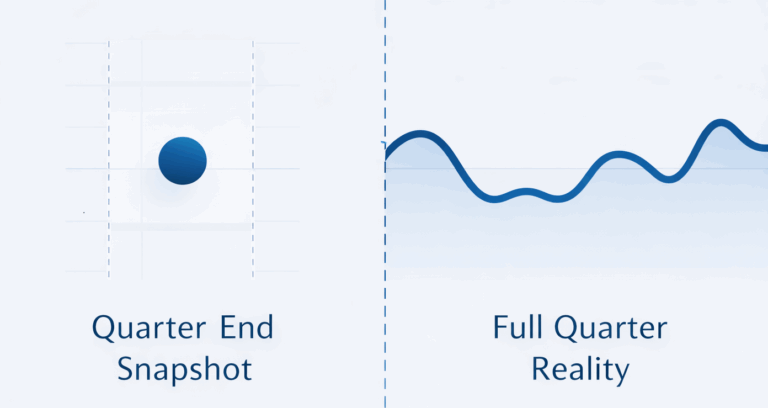
Here are sneaky risks that quarterly in advance introduces that firms continually write off as “it all works out in the end” but is quietly costing revenue, introducing risk and making them look dumb in front of clients.
1. Revenue Timing Risk
Market movements, deposits, or withdrawals after the snapshot causes revenue to be over- or under-collected. Your billing is wrong 99% of the time.
2. Client Confusion
Clients may not understand why fees are billed on assets they no longer hold or why their mid-quarter deposits are calculated and reflected. They may withdraw or move money mid-quarter that they’ve already paid management fees on.
3. Cashflows
Clients who deposit or withdraw after the advance billing snapshot may require prorated refunds, which are impossible to calculate.
4. Unfair to Clients.
Quarterly-in-advance billing can unintentionally penalize or benefit clients based on timing. Clients who add assets mid-quarter will get these managed on the house, while those who withdraw during the quarter pay for assets they no longer hold.
5. Mismatch in value
Fees are determined by a snapshot, not actual ongoing account activity, creating a mismatch between value delivered and value billed.
6. Single-Day Valuation Risk
Billing quarterly in advance makes the snapshot day disproportionately important. On that day, values may not yet be fully updated, for example dividends, transfers, or market movements can be missing, yet fees are calculated as if they are final. Because so much rides on this single day, it often triggers a last-minute scramble to review and ensure the numbers match what the firm actually wants to bill.
7. Lost revenue
Markets go up over time, in fact 7 out of 8 quarters. Yet, when you have billed your fee on the first day of that quarter, you are missing revenue for work you are doing every day the market goes up. Subsequently, you are overbilling the client when the market goes down over the quarter. In fact, we found that fees differ between 2-4.5% between two firms, just because of the methodology used.
So What Do You Do With This?
This is usually the point where firms ask, “Okay… then what?”
The answer isn’t that quarterly billing is “wrong” or that you need to rip out your entire fee structure tomorrow. But it does mean the timing deserves the same level of scrutiny you already apply to fees, compliance, and client experience.
Some firms start by stress-testing their current approach and simply measuring the drift. Others adjust how and when fees are calculated to better reflect actual asset movement. Some land in a hybrid model that keeps what works while removing the single-day risk baked into the process.
The important part is this: once you see timing as a variable, you can’t unsee it.
If revenue, fairness, and defensibility matter—and they do for every growing RIA—then billing isn’t just an operational task anymore. It’s a lever. And like any lever that touches revenue, it’s worth digging into before assuming it all “works out in the end.”
 The Quarter End Blind Spot